
The 2026 National ICHRA Report
The most comprehensive look at the ICHRA market available from any single administrator. Drawing on data from Remodel Health and PeopleKeep platforms, this report reveals how employers and benefits consultants are designing ICHRA benefits, how employees are choosing coverage, and what it takes to administer ICHRA successfully in 2026 and beyond.

Introduction
Traditional group health insurance has long been the standard for employers and their benefits consultants. However, rising premiums, rigid structures, and diversifying employee needs have led many to consider alternatives. Much like the shift from pensions to 401(k)s for retirement benefits, the individual coverage health reimbursement arrangement (ICHRA) moves from a defined health benefit structure that organizations manage to a defined contribution model that employees manage. This shift enables employers of any size to reduce their benefits spend and exit the group health insurance business.
With ICHRA, organizations can offer a defined contribution for employees to spend on individual health insurance plans and, depending on plan design, qualifying out-of-pocket medical expenses. Employers get predictable costs, and employees get more choice in their health insurance networks and costs.
Thanks to the flexibility and personalized nature of ICHRA, its popularity has increased significantly since its introduction in 2020. According to the HRA Council, of which Remodel Health is a member organization, ICHRA adoption has grown more than 1,000% since 2020.
Whether it’s a small business offering health coverage for the first time or an enterprise employer seeking cost-effective solutions for its multi-state team, ICHRA empowers employers to provide tailored benefits that meet their workforce’s needs.
As the leading ICHRA administrator by revenue, the Remodel Health 2026 National ICHRA Report analyzes data and trends from the largest vendor-specific dataset available, from average employer size and industry to carrier payments. Because we manage the end-to-end ICHRA experience for more than 100,000 members, we are uniquely positioned to bridge the gap between high-level strategy and operational reality, providing the industry with the most comprehensive vendor-specific dataset available.
In this report, you'll learn:
- How ICHRA has grown from a niche alternative to a mainstream benefits strategy, and what policy, market, and workforce trends are driving that momentum.
- Which industries, employer sizes, and geographies are adopting ICHRA.
- How employers of all sizes are structuring their ICHRA contributions.
- Which plan types employees are choosing on the individual market, including metal tiers and network types.
- What it takes to administer ICHRA at scale, including the operational complexity of premium payments, and why execution matters more than ever.
The 2026 National ICHRA Report includes:
What is ICHRA?
A brief overview of the ICHRA and how it works.
The state of ICHRA in 2026
A look at the growing interest and trends with ICHRA in 2026. This includes examining HRA Council and HealthSherpa membership data, exploring the trends we're seeing in the new to coverage space, how more group brokers are placing ICHRAs, the rise in enterprise employers, and momentum in the federal and state legislative landscape.
Who uses ICHRA?
Which types of employers are offering an ICHRA in 2026, including average size, most popular states, and industries.
ICHRA contributions
A look at the average ICHRA contributions offered by family size, employer size, state, and industry.
Employee plan choice on the individual market
Which plans employees select on the individual market, including metal tier breakdowns, plan networks, and exchange types.
ICHRA plan design
How employers use waiting periods and whether they offer a premium-only ICHRA or also allow for reimbursement of out-of-pocket medical expenses.
The challenges ahead
Why your ICHRA partner matters more than ever.
ICHRA by the numbers in 2026
$591
The average monthly ICHRA contribution employers offered self-only employees in 2025, just below the $625 average benchmark premium for a 40-year-old on the ACA exchanges.
14
The average number of unique health insurance plans employees collectively choose within a single organization offering ICHRA, ranging from 1 to 534 depending on employer size and workforce distribution.
137%
The year-over-year increase in businesses that switched to Remodel Health from another ICHRA vendor in 2025, including one of the company's largest enterprise clients to date.
$136.5 million
The total amount of ICHRA premium payments Remodel Health processed on behalf of members in 2025, across more than 60 insurance carriers nationwide.
455%
The growth in applicable large employers (ALEs) using Remodel Health's ICHRA+ platform between February 2024 and 2026.
31%
The share of employees who chose a Gold-level plan for 2026 on the individual market.
Employee plan choice on the individual market
An ICHRA gives employees the freedom to choose the individual health insurance plan that best fits their needs. To participate in an ICHRA, employees need either a qualifying individual health plan, Medicare Parts A and B together, or Medicare Part C, also known as Medicare Advantage.
With multiple carrier and plan options available in most rating areas, employees can use their ICHRA contributions to purchase a plan that works with their doctors, prescriptions, and budget.
That freedom is meaningful, and employees are using it thoughtfully. Rather than defaulting to the lowest-cost option, employees are weighing metal tiers and network types based on their individual circumstances. The result is a distribution of plan choices that looks quite different from what you would see in a traditional group health setting, where a single plan design is applied to an entire workforce regardless of individual need.
To understand what employee choice looks like in practice, consider this: across Remodel Health’s ICHRA+ platform, employees select an average of 14 unique health plans per organization. That ranges from a single plan at the smallest employers to 534 distinct plans at the most complex. Compare that to the traditional group health model, where every employee receives the same one.
The data below breaks down how employees enrolled through Remodel Health are making those decisions.
Metal tier breakdowns
Employees can choose from four plan metal levels: Bronze, Silver, Gold, or Platinum. This choice is crucial because it reflects the plan's actuarial value and the out-of-pocket expenses employees can expect.
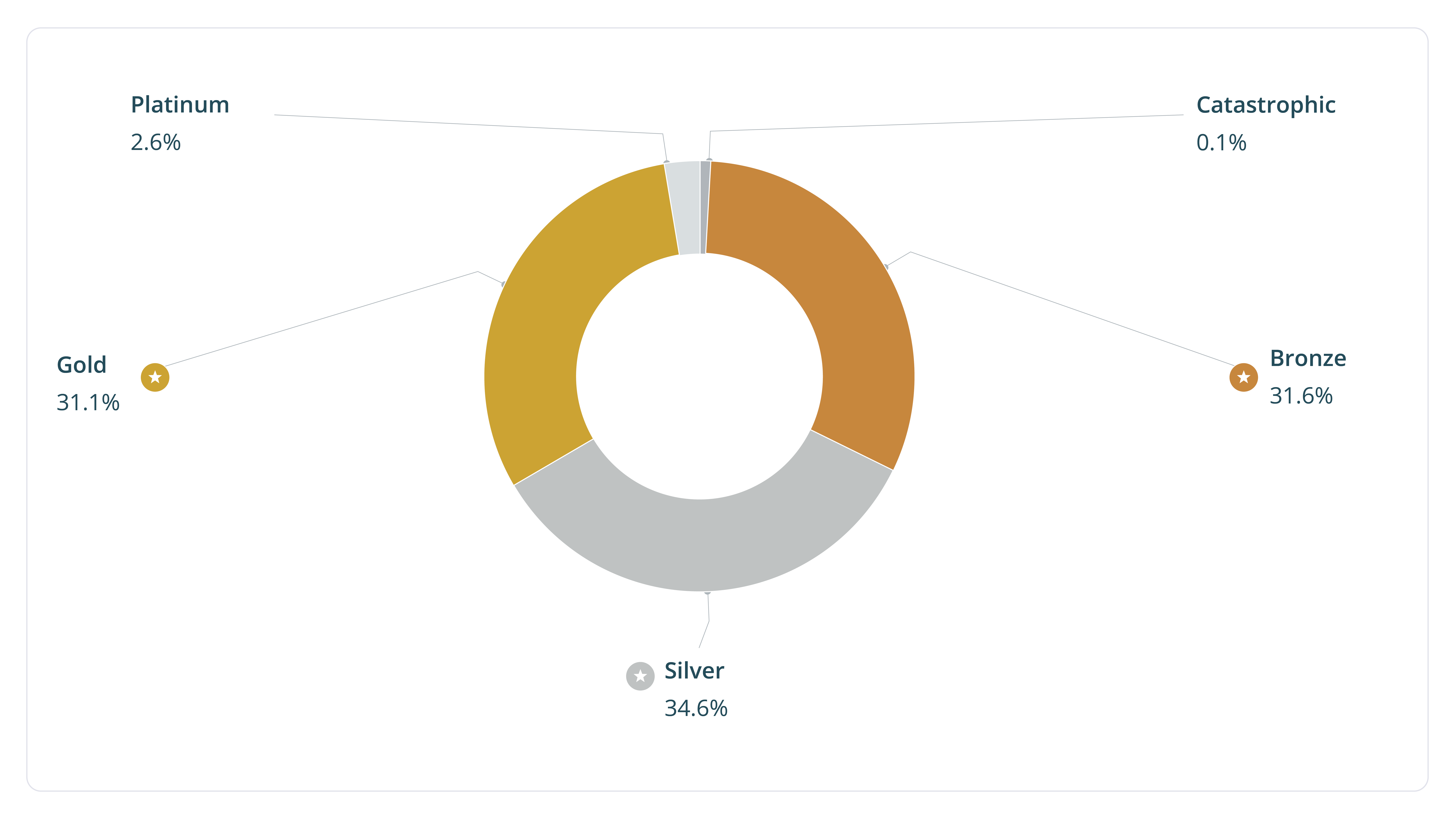
The data shows a near-even distribution across the three most common metal levels (Platinum plans aren’t available in all locations), with a slight preference for higher value plans. Most employees chose a Silver plan (34.58%), followed by Bronze (31.63%) and Gold (31.13%). Only 2.55% of employees chose a Platinum plan, the type of plan with the highest average premiums. Less than 1% of employees chose a catastrophic plan.
This shows that employees aren’t simply choosing the cheapest plans on the market. Instead, they’re choosing plans that meet their needs and provide meaningful coverage.
While Bronze and catastrophic plans are cheaper than other metal levels, employees choosing them aren’t necessarily prioritizing cost savings over coverage. As of 2026, all on-exchange Bronze and catastrophic plans, including their mirrored off-exchange versions, are HSA-eligible16. These employees may have received an HSA contribution offer from their employer, allowing them to easily take advantage of both an ICHRA and an HSA.
As long as an employer offers a premium-only or limited-purpose ICHRA to employees with an HSA, they can contribute to the benefit and save money for future out-of-pocket medical expenses.
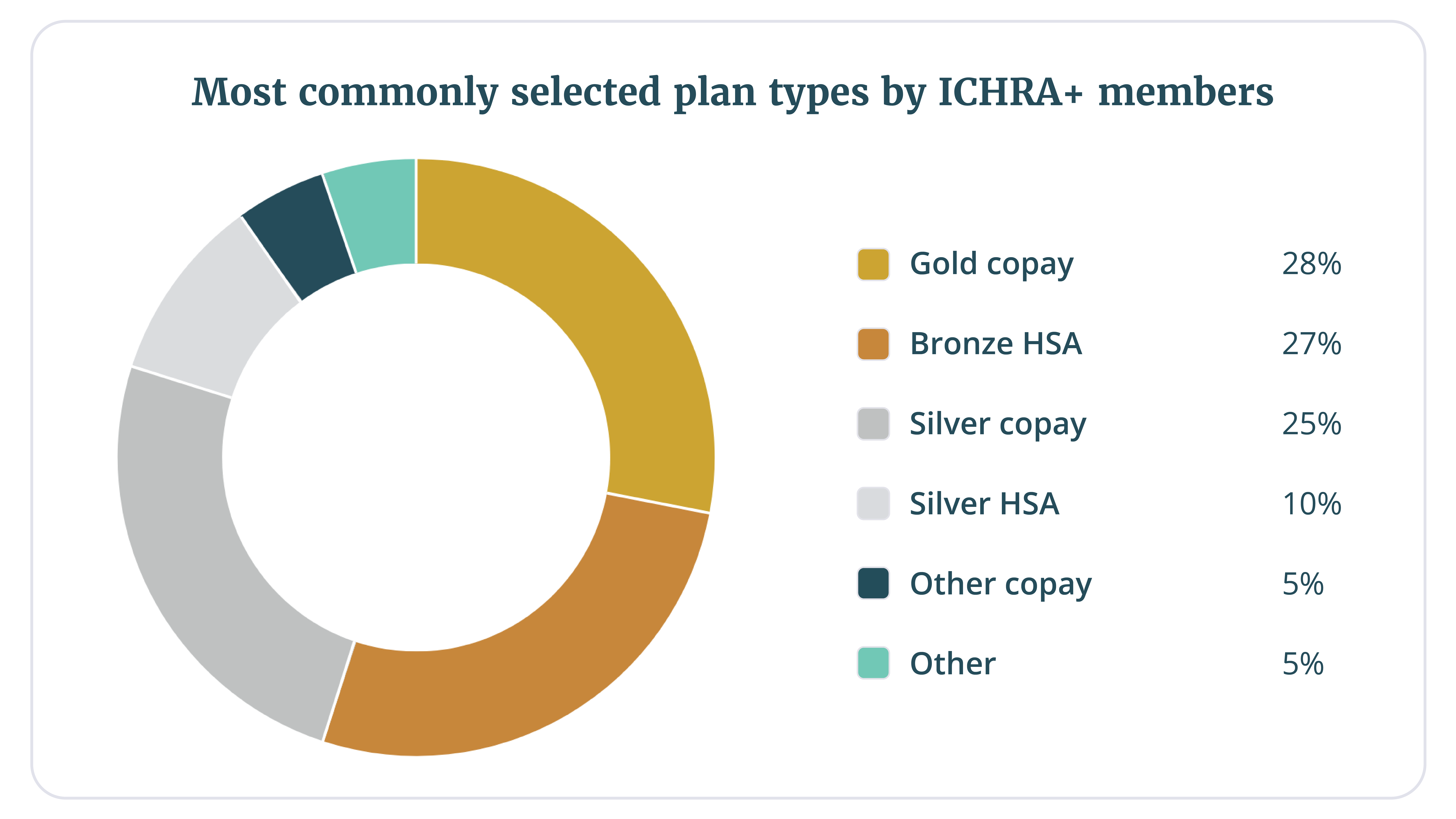
Looking more specifically at plan types among ICHRA+ platform members, the most commonly selected plan types were:
Gold copay plans (28%), Bronze HSA (27%), Silver copay (25%), Silver HSA (10%), Other copay (5%), and Other (5%).
Gold copay plans, which lead the list, reinforce that employees are willing to pay higher premiums in exchange for predictable out-of-pocket costs through copays rather than higher deductibles. Bronze HSA plans at number two validates that employees are actively pairing ICHRA with HSA-eligible plans, a trend worth watching as HSA awareness grows among individual market shoppers.
Plan network type
We also looked at which network types were most common among customers’ employees with an ICHRA.
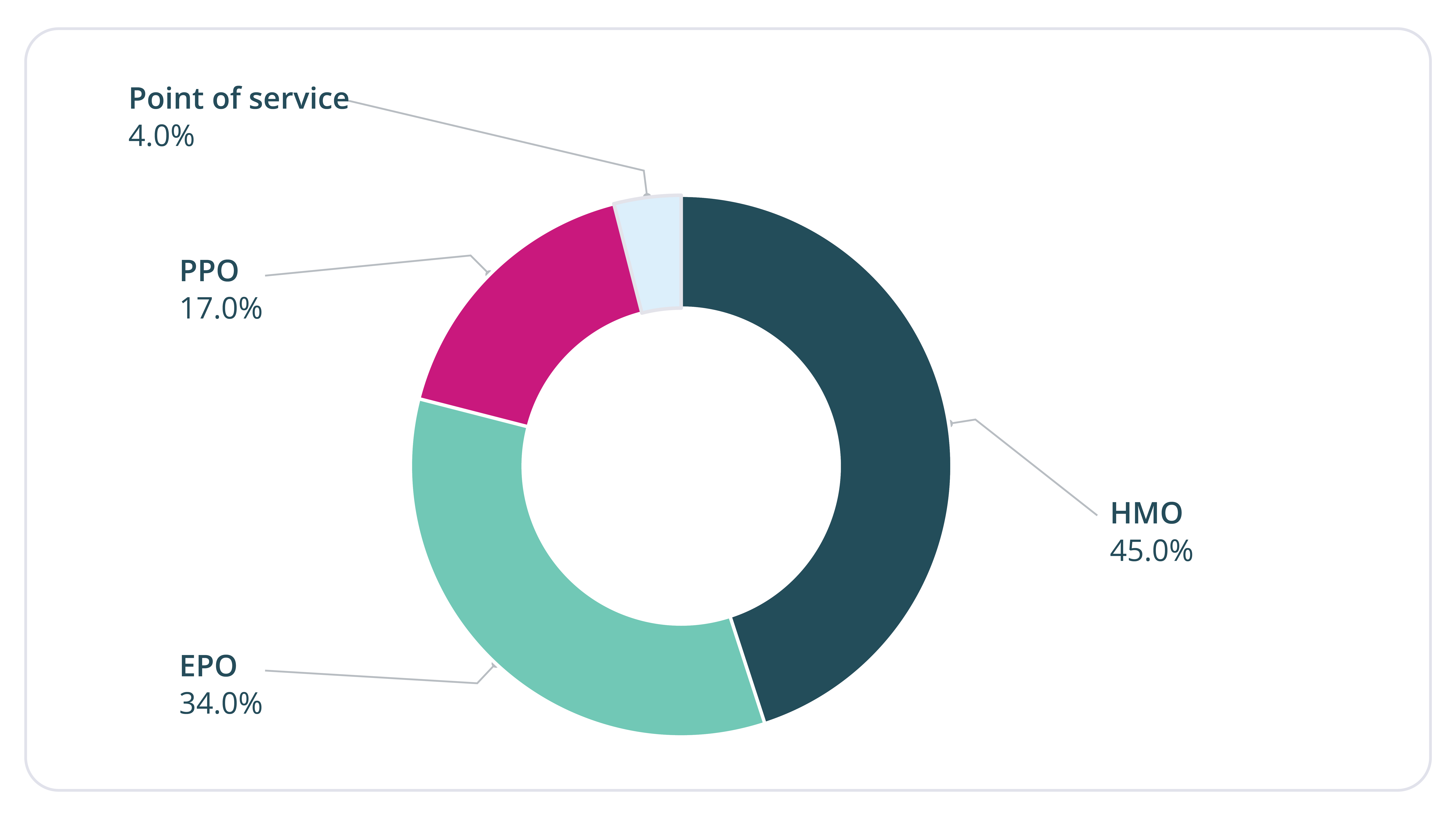
Nearly half of all members had a health maintenance organization (HMO), with 45%. This was followed by exclusive provider organization (EPO) at 34%, preferred provider organization (PPO) with 17%, and point of service (POS) with 4%.
It’s worth noting that HMO and EPO plans make up the majority of available plans on the individual market in most rating areas (roughly 84% in 2021).17 So, the distribution reflects both market availability and employee preference.
When metal tier and network type are combined, the five most common plan combinations among ICHRA+ platform members were: Silver HMO (17%), Bronze HMO (15%), Silver EPO (13%), Gold EPO (12%), and Gold HMO (10%).
Want more? Download the report
Download the full report to get all the data and details.

About Remodel Health
Remodel Health is the most trusted and operationally reliable ICHRA partner for large employers. We offer the most complete ICHRA service model in the industry, combining intuitive technology with expert, personalized support. Since 2015, we’ve helped employers across the country transition to modern, flexible health benefits. We partner with brokers to bring this smarter group funding solution to life, delivering a streamlined experience for both benefits administrators and employees.
From benefit design to renewal, we walk customers through every step of the ICHRA process, helping them navigate each stage with clarity and confidence. Whether you’re replacing a group plan or rethinking your benefits strategy, Remodel Health makes it simple, scalable, and built to last.