
By Elizabeth Walker on May 27, 2026, 7:28:01 AM


In previous years, coordinating Medicare with individual coverage health reimbursement arrangements (ICHRAs) could be a compliance challenge for many employers. Whether business owners were required to send Medicare Part D creditable coverage notices when offering an ICHRA was a major source of confusion, especially if they were new to the health benefit and unfamiliar with the various compliance regulations.
However, the Centers for Medicare & Medicaid Services (CMS) recently released a final rule that removes this administrative burden for brokers, HR teams, and large employers offering ICHRAs in 2027.
This article explains the changes the new CMS rule introduced so you can prepare for the 2027 plan year and ensure your ICHRA complies with federal guidelines.
In this blog post, you’ll learn:
- What the new 2027 CMS final rule entails, and why this change simplifies compliance for employers offering an ICHRA.
- What employers previously had to do to comply with Medicare Part D disclosure rules, and which administrative tasks they no longer need to complete.
- When Medicare Part D notice requirements may still apply for employers who offer both a traditional group health plan and an ICHRA.
What changed for ICHRAs and Medicare Part D creditable coverage notices in 2027?
In April 2026, CMS released a final rule exempting account-based plans — including ICHRAs and health flexible spending accounts (FSAs) — from Medicare Part D creditable coverage disclosure requirements. This new rule will apply to coverage beginning January 1, 2027.1
Before this change, it was difficult for employers to measure if their ICHRA met the Medicare Part D standards because the benefit alone wasn’t actual insurance coverage. This led to confusion and uncertainty when fulfilling compliance requirements.
In most cases, employers had to:
- Determine whether their ICHRA qualified as “creditable coverage” using actuarial value.
- Complete the Creditable Coverage Disclosure Form on the CMS website annually.
- Distribute Medicare Part D notices of creditable coverage to eligible employees and dependents before October 15 each year, before joining the plan, and upon request.
The new rule streamlines compliance for employers, making it easier to administer the ICHRA for Medicare-eligible employees.
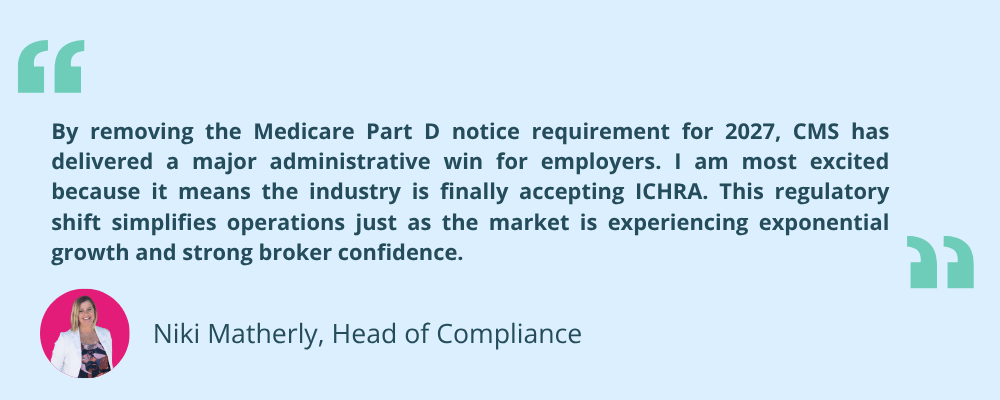
“By removing the Medicare Part D notice requirement for 2027, CMS has delivered a major administrative win for employers,” Niki Matherly, Head of Compliance at Remodel Health, said. “I am most excited because it means the industry is finally accepting ICHRA. This regulatory shift simplifies operations just as the market is experiencing exponential growth and strong broker confidence.”
Why did CMS eliminate the Part D Notice requirement for ICHRAs?
Medicare Part D creditable coverage notices help Medicare-eligible individuals understand whether their employer-sponsored prescription drug coverage is at least as valuable as standard Medicare Part D coverage.
However, an ICHRA doesn’t work like traditional health coverage. With an ICHRA, the employer offers their employees a tax-free monthly allowance that employees can use to buy individual health plans. The employer isn’t sponsoring a prescription drug benefit directly. Instead, the employee’s chosen individual policy provides coverage for prescription medication, and their ICHRA allowance goes toward the plan’s monthly health insurance premiums. Therefore, the ICHRA doesn’t provide creditable coverage.
Because of how ICHRAs and other account-based plans work, CMS decided that asking employers to measure the actuarial value of these types of health benefits against Medicare Part D prescription drug plans wasn’t feasible.
CMS wrote that, “given that account-based entities do not offer such coverage, we proposed to revise § 423.56(b)(3) so that account-based entities are not required to provide the creditable coverage disclosures. Furthermore, requiring account-based plans, such as HRAs, including ICHRAs, to determine if their coverage is creditable, and requiring them to report the creditable status of that coverage, unduly increases administrative burden on these entities by causing them to expend additional resources and expertise that they may not possess.”
What do employers need to do after the 2027 CMS rule takes effect?
Beginning with coverage effective January 1, 2027, employers offering HRAs, including ICHRAs, and health FSAs no longer have to provide Medicare Part D creditable coverage notices and other related tasks.
However, employers offering account-based plans should work with a health benefit advisor or broker to ensure they’re following the new CMS rule properly.
After the change, employers generally won’t have to:
- Determine whether an ICHRA is creditable or non-creditable coverage.
- Send annual Part D notices related to the ICHRA to eligible employees.
- File related Medicare Part D disclosures specifically related to the account-based group health plan.
- Coordinate actuarial evaluations for HRAs, ICHRAs, or health FSAs.
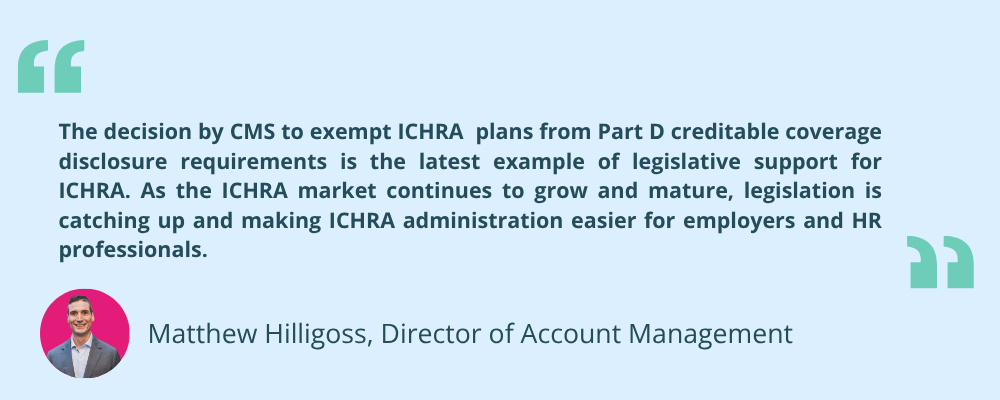
“The decision by CMS to exempt ICHRA plans from Part D creditable coverage disclosure requirements is the latest example of legislative support for ICHRA,” Matthew Hilligoss, Director of Account Management at Remodel Health, said. “As the ICHRA market continues to grow and mature, legislation is catching up and making ICHRA administration easier for employers and HR professionals.”
If you offer both a traditional group health plan and an ICHRA, do you still need Part D coverage notices?
Yes. The new CMS exemption only applies to account-based health plans, including the ICHRA. If you’re offering an ICHRA and a traditional group plan at your organization, the Medicare Part D disclosure requirements may still apply to your group coverage.
You can offer group coverage and an ICHRA compliantly as long as you don’t provide both options to the same employee class. For example, you can offer a traditional group health plan to your full-time employees and an ICHRA to your part-time workers.
In this situation, you may still need to provide Medicare Part D creditable coverage notices for the traditional group plan, even though your ICHRA is exempt from the requirement.
So, it’s important to understand all your benefit offerings and their individual compliance rules so you don’t fall subject to costly penalties.
Conclusion
By recognizing that ICHRAs reimburse individual health plans rather than directly provide employees with prescription drug coverage, CMS removed a compliance requirement that created confusion and extra administrative tasks. However, employers offering both traditional group health coverage and an ICHRA should still review their plans carefully to ensure they’re following all required disclosure requirements for each employee benefit.
At Remodel Health, we help employers and brokers keep ICHRA plan administration simple so you never have to worry about making a mistake. Plus, our in-house Medicare team can also help answer questions related to Medicare coordination and compliance requirements. Contact us at Remodel Health to learn more about how we can help you offer an ICHRA.
References


A look at the growth of ICHRA
Explore the growth of ICHRA and its increasing popularity among businesses. Learn why employers are choosing ICHRA for flexible health benefits.

Who is eligible for ICHRA?
Wondering who qualifies for ICHRA? Explore ICHRA eligibility rules for employees and how employers can structure classes to meet compliance and coverage goals.

Who can use an ICHRA?
Learn who is eligible for ICHRA and how it works. Discover which employees can participate and what employers need to know about offering ICHRA.