By Holly Bengfort on Apr 29, 2026 1:11:55 PM

Employers seeking more control over health benefit budgets often compare alternative strategies, such as reference-based pricing (RBP) and the individual coverage health reimbursement arrangement (ICHRA).
Both aim to lower costs and give employers more flexibility than traditional group health plans. However, they accomplish these goals in different ways.
In this article, we’ll break down how RBP compares to ICHRA so you can determine which strategy best fits each unique employer group.
In this blog post, you'll learn:
- What RBP and ICHRA are.
- How each model impacts healthcare costs and employee experience.
- How these strategies compare.
What is reference-based pricing?
Reference-based pricing (RBP) is a cost-containment model used in self-funded health plans to manage healthcare costs.
Instead of relying on traditional provider networks or negotiated reimbursement rates with health insurers, employers set a maximum amount allowed for medical services based on a benchmark1. The benchmark is often tied to Medicare or other standardized healthcare pricing data.
Here’s how it works:
- The employer sets a fixed reimbursement level.
- A third-party administrator, such as Occunet or Imagine360, reprices claims using that benchmark.
- If a provider charges more than the allowed amount, the employee may be responsible for the difference (known as balance billing).
An RBP solution can reduce claims costs. But it often requires additional oversight from third-party administrators (TPAs) and insurance providers supporting the arrangement.
What is an ICHRA?
An individual coverage HRA (ICHRA) is an employer-funded, defined contribution health benefit. With an ICHRA, employers provide employees with a tax-free allowance to purchase individual health plans.
Instead of managing claims costs or negotiating reimbursement rates with healthcare providers, employers set a fixed monthly budget.
Here’s how it works:
- The employer sets their contribution amount. They can vary allowances based on 11 employee classes, or by age and family size.
- Employees choose the individual health plans that fit their needs.
- Employees use their allowances on individual health insurance premiums.
This approach gives employees more transparency around healthcare pricing and reduces employer exposure to fluctuating medical services costs.
RBP vs. ICHRA comparison chart
The biggest difference comes down to how each model manages healthcare costs. One adjusts pricing within the healthcare system, while the other moves to a defined contribution model.
The chart below shows how the RBP and ICHRA compare.
|
Reference-based pricing (RBP) |
ICHRA |
|
|
Cost model |
Cost-containment model based on reimbursement rates |
Defined employer contribution (fixed allowance) |
|
Cost control |
Caps the amount reimbursed to healthcare professionals |
Controls employer healthcare costs upfront |
|
Claims costs |
Dependent on medical treatment |
Employers face no direct exposure to claims costs |
|
Balance billing risk |
Possible balance bill for employees |
No balance billing |
|
Out-of-pocket expenses |
Can be unpredictable depending on provider charges |
More predictable due to a defined employer contribution |
|
Employee experience |
May involve billing disputes with providers |
Employees choose from traditional health insurance |
|
Cost savings |
Achieved through reduced reimbursement rates |
Achieved through a defined employer budget |
|
Administration |
Complex |
Simplified through an ICHRA administration platform |
|
Healthcare pricing transparency |
Limited and variable healthcare pricing |
More standardized through health insurers |
Key considerations for employers and employees
While the comparison chart highlights the differences between RBP and ICHRA, it’s also important to understand the real-world friction points each model introduces for both employers and employees.
RBP considerations
For employers, RBP can still expose them to variability in healthcare costs, particularly through high-dollar claims and year-over-year volatility in stop-loss premiums. While the model aims to reduce reimbursement rates, claims exposure doesn’t disappear.
Employers may also find it difficult to assist employees when balance billing issues arise. Resolution often depends on third-party administrators and provider negotiations.
For employees, balance billing is one of the most significant friction points. Unexpected bills from healthcare providers can feel confusing and frustrating. Employees will rely on the RBP administrator to resolve disputes with healthcare systems.
ICHRA considerations
For employers, ICHRA introduces meaningful change management during implementation. Setting up classes, determining allowances, and transitioning away from a group health plan requires upfront coordination and internal alignment.
Additionally, employers shift out of the role of plan sponsor and into a defined contribution model. That means HR teams may no longer be able to answer detailed questions about specific health plans, carrier networks, or coverage differences. This is because employees are selecting plans from the individual market.
For employees, the biggest friction typically shows up in year one. The shift from a single group health plan to multiple plan options can be confusing, especially for employees unfamiliar with shopping for individual health insurance.
However, working with an ICHRA administrator like Remodel Health reduces friction.
Expert perspective
TJ Witham is the Vice President of Broker Sales at Remodel Health. He said the choice between RBP and ICHRA often comes down to an employer’s philosophy on risk, flexibility, and long-term benefits strategy.
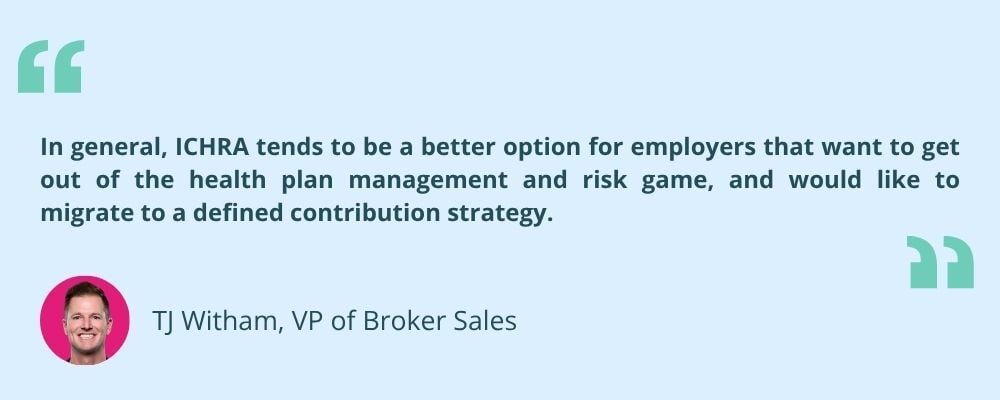
“In general, ICHRA tends to be a better option for employers that want to get out of the health plan management and risk game, and would like to migrate to a defined contribution strategy,” Witham said.
However, he also points out that ICHRA’s effectiveness depends heavily on geography and access to individual market plans. In some states, employees may face higher premiums or more fragmented provider networks. In contrast, others offer very competitive and robust options.
“The best employers will work cohesively with their employee benefits consulting team to evaluate which funding alternative best supports their long-term goals,” Witham said.
Offering an ICHRA through Remodel Health
Employers evaluating ICHRA often need support navigating healthcare pricing, employee communication, and health plan selection across multiple insurance providers.
Remodel Health helps organizations design and implement ICHRA solutions that align with their budgets, workforce needs, and long-term health benefit strategy. By simplifying administration and supporting workers through plan selection, Remodel Health helps improve employee satisfaction while maintaining predictable healthcare spending.
For employers comparing alternatives like an RBP solution or other cost-containment tool, having a structured implementation partner can help reduce complexity and improve outcomes across both cost savings and employee experience.
Conclusion
Reference-based pricing (RBP) and ICHRA both aim to address rising healthcare costs, but they take very different approaches. RBP focuses on reducing what's paid to healthcare providers. ICHRA focuses on budget predictability. If you want to offer an affordable, personalized health benefit to your team, Remodel Health can help!
References