By TJ Witham on Mar 19, 2026, 7:15:00 AM
.png?width=2104&height=1182&name=Screenshot%202026-03-19%20at%2011.20.10%20AM%20(1).png)
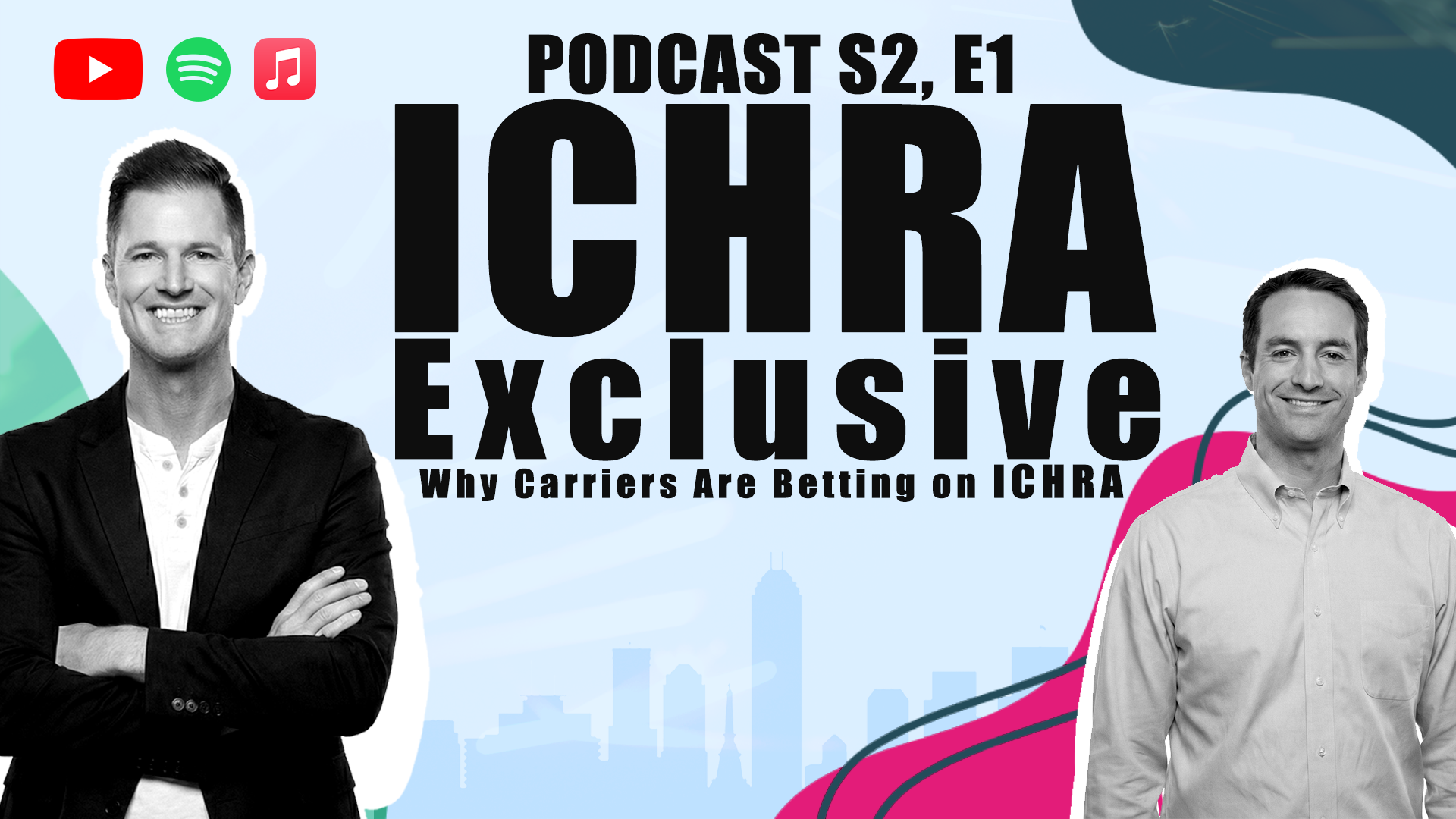
The ICHRA Exclusive Podcast is back with another must-listen episode—and this time, we’re spotlighting one of the leading voices shaping the future of ICHRA.
Joining us is Andrew Loehr, Area Senior Vice President of Consulting at Gallagher, who has been at the forefront of the Benefits and HR landscape. In this episode, Andrew pulls back the curtain on Gallagher Indiana’s “secret sauce” to success, while offering a candid look at the realities large employers face in today’s rapidly evolving healthcare environment.
As ICHRA continues to mature, we dive into the latest legislative developments impacting the space and what they mean for employers considering this strategy. Andrew also shares what drew him to focus on ICHRA within the healthcare industry—and how that focus is playing out in real-world applications.
We explore the biggest hurdles large employers encounter when transitioning to ICHRA, from scale and complexity to change management and employee adoption. Plus, Andrew gives his perspective on what truly sets Gallagher Indiana apart in a competitive and ever-changing market.
Looking ahead, we close with Andrew’s bold predictions for the next five years—and the one change he believes could unlock the next phase of growth and maturity in the ICHRA landscape.
If you’re a large employer evaluating ICHRA, navigating increasing healthcare costs, or looking for insight from a proven industry leader, this episode is for you.
Watch or listen to the ICHRA Exclusive podcast
Episode transcript
Andrew Loehr: Even some of these rural hospitals, they're losing service lines. There was one just south of Indiana that just lost their OB-GYN. And you think, a community losing that. I think we're massively missing the point. We're trying to limit what the costs are. We talk a lot about health insurance, but really we should be delivering healthcare.
TJ Witham: Joining us is Andrew Loehr, Area Senior Vice President of Consulting at Gallagher. Andrew's been at the forefront of the benefits and HR landscape, and today he's sharing the secret sauce behind Gallagher of Indiana's success, the biggest challenges large employers face, and his bold predictions on where the market's headed.
We'd love to have our audience get to know you just a little bit. You've been a vet in healthcare consulting, over 20 years, you said. I'd love to start: how did you get into the business?
Andrew Loehr: So it's been 26 years, actually, that I got into the business. I went to school for hospital administration, business and hospital administration, at IU, who are finally on the map for football, so that's good. I got out of school, did an extra semester just for the fun of it, because I changed my major so many times, and I wound up with like three different degrees, hospital administration being one of them. Long story short, I'm going to save you some of the boredom: I didn't do hospital administration, but I did live in a tent for a year and guided whitewater. I was at a desk doing sales and some other work, and I was like, there's got to be something better. So I went out, sold everything I had, and lived in a tent for about a year.
TJ Witham: Wow.
Andrew Loehr: And then I came back and got a job with Aetna. It was my first job back, and that was probably in 1997. So I started on the carrier side; I worked in their small group, and then I realized there's some help that can be done in this space. So I opened up my own shop about two and a half years into the business, doing small group, got licensed in investments, started doing 401(k)s, individual life insurance, group health benefits. I did that for four years, and then I ran into some folks at Gallagher, and they bought my block of business. I've been there 18 years.
TJ Witham: Yeah, 18 years. And I can speak, I've interacted with your team, one of the best teams in employee benefits consulting. You've worked to build an awesome unit of people, a team that loves working together and adds a lot of value to the clients you serve.
Andrew Loehr: I appreciate you saying that, because we've got Mark and Christine, who I work very closely with, you know them. And I think, like you said in the beginning, the secret sauce, it's the team, and it's people that care about each other, people that care about clients, and people that care about learning and continuing to drive. I've been at Gallagher 18 years. My plan was three years. I figured I'd sell my business and then go do something else. But it's learning every day, and being around people that have that same thirst, because this business can...
TJ Witham: So you had a three-year earn-out that's turned into 18. So it's going strong.
Andrew Loehr: Yeah, I think I got the raw end of that deal somehow. But from a career perspective, it's been one of the best things. Great organization, and I've been lucky enough to work with some great people. We do a lot in the healthcare space, so we work with a lot of hospitals, a lot of ortho groups, a lot of physician practices, health clinics. I think that's about 80% of our business, which kind of goes in line with my hospital administration degree, so everything comes together. We've made quite a mark in that industry, and Gallagher as a whole, from Indiana Healthcare, we've probably got 3,500 people across the country that work in the healthcare vertical. So we've got quite a powerful team, a lot of thought leadership in that team. Just really excited to be part of that.
TJ Witham: Yeah, I love you and Mark and Christine and that team. We call you guys the black belts of the healthcare group, just knowing what you know, because it's unique. When you work with healthcare groups, the average knowledge of employees on general healthcare and health insurance is higher than most, which can be a great thing. It can also create some challenges, when people know more, sometimes you have to think through differently how you roll different things out to nursing staff and people who really understand how the system works. From the clinical standpoint, they know more than the average layman. I'd love to, for a second, chat about your first experience with ICHRA for a hospital, which I know was a couple years ago at this point.
Andrew Loehr: That's a good question. Just kind of teeing that up a little bit, I think you mentioned employee communication, weaving that in, in the healthcare space, and they know more, they're familiar with the delivery system. The health insurance system that's driving it is a lot more confusing. In the healthcare space, there is more utilization. So you look at a manufacturer, and you look at a company that is a health provider; in a way, they understand that there's access here and there.
TJ Witham: So they use the plan, because they know how to make it work for them.
Andrew Loehr: So a lot of these costs are higher than the average employer, and it is complicated.
These healthcare organizations- the reason why we're so excited about it, and working with Mark and Christine and our healthcare vertical- is there's a lot of work to solve for them. It's a more complicated equation. And I think there's a disconnect on what the employees understand that full investment is. Making that connection- what their premiums are and their deductibles are- is only just a portion of that iceberg. There's a huge, building-size iceberg under there that the employer is subsidizing. So, trying to connect those dots.
Leading into your question about the first entry into the ICHRA space, which is fascinating, I think it's something that healthcare organizations that provide healthcare for their domestic staff need to explore. So we were working with an organization, not a large one, an independent hospital. You're always looking to solve problems, and I look at it like you're putting sandbags out to keep the floodwaters at bay and keep costs in control for everybody. What's fascinating about this is the entry to ICHRA starts because you've got an organization that has to comply with ACA regulations. I've got to cover this; I've got to cover that. When you're working through renewals and planning throughout the year, it's, okay, we want to cover that, we want to make sure that's taken care of, how do we find the right balance, how do we charge the right amount?
But as you're working through that, you've got a population where you could have some kind of gene therapy medication that needs to happen, or there are cancers there. The reinsurer doesn't have to insure them; they don't have to play by the same rules. So you're going to try to get stop loss, and you say, we're going to cover all the claims up to $100,000. And the stop-loss carrier says, okay, that's fine, here's your premium. But oh, yeah, that person that's really sick, and that person that's really sick, and that person over there that's got an upcoming surgery, we're going to laser them from the contract. So at the end of the day, at 200, 300, fill in the blank on the size of employer, but the smaller ones, when you get lasers, that could be like two or three million dollars of extra exposure. So the entry to it is looking at what our exposure is. And I don't even want to get started; it drives me crazy that the employers have to uphold the healthcare systems, but the people reinsuring them can cherry-pick.
TJ Witham: Yeah.
Andrew Loehr: It's bananas. That doesn't happen in the individual health space.
TJ Witham: That's one of the main problems it solves. When they passed the ACA, it's guaranteed issue, so there's no cherry-picking anymore in the individual health market, which there used to be pre-ACA. That was underwriting; you could cherry-pick. That's one of the things that once a business leader learns, and is reminded of, the guaranteed-issue nature of the individual market, if they've been running a self-funded plan forever where they're used to that stop-loss carrier being able to cherry-pick, it's almost like you have to tell them twice before, they're like, wait, wait, you're telling me that there's no pre-existing conditions or past claims or specialty drugs impacting the rates of people?
Andrew Loehr: On your ICHRA.
TJ Witham: On an ICHRA, in the individual market. And you're like, yeah, that's what I said, that's what I meant. And they're like, wow.
Andrew Loehr: They're used to seeing, oh, I've got a $500,000 laser on this person, my exposure could be a million on this one. So the employers are propping up America's healthcare system, subsidizing Medicare and Medicaid. Give them a break. Help them with that, with what they do in return. So I say that, but they load it into premium. Oh, I don't want a laser? Okay, well, you're going to get that same million, two million, thrown into premium. So an employer can't cherry-pick on that. So, enter this healthcare organization. We were looking at everything, how do we keep the employee experience at a good level, how do we keep the cost down? We achieved everything in this. And it's interesting when I say everything: the employees' premiums were able to go down, they were able to customize their coverage, and the employer could say this is exactly how much it's going to cost me, not, okay, that's a good month in claims, okay, that's double what I expected, okay, I'm back down here. We just created some continuity for the CFO to budget. Really.
TJ Witham: Yep.
Andrew Loehr: So it changed the game for that organization, and it opened my eyes to, okay, if it can work like this, this can work in other ways. And we've talked about this before, that for a healthcare system, what's the other benefit of that?
TJ Witham: The other benefit is, oftentimes, because these healthcare system workers are such high utilizers, there's premium savings moving to ICHRA and leveraging individual plans. But then there's a double benefit, in that as long as your employees, which most in a hospital system do, as long as they continue to utilize the services provided by the hospital, we would call those domestic claims, that actually becomes revenue potential to the hospital, where now those individual carriers are reimbursing for those claims into the hospital, which is actual revenue in the door, versus in a self-funded plan. I always say, and I think you say the same, it's kind of in a self-funded plan the money goes from the left pocket to the right pocket, because it's the hospital paying themselves.
Andrew Loehr: It's like a restaurant giving their employees free food. But there's still the cost associated with that. So we're still measuring some of what that is, just because it's all individual policies. We've chatted with a couple CFOs on it, and it's like, they wrote off those claims, and now they're having a third-party payer- it might be an Anthem, United, Ambetter, or CareSource, fill in the blank- but what they were writing off is now actually revenue. We've been partnering up, looking at some solutions to help drive that domestic utilization, to help increase that and take care of the employees. Because I think what we've talked about, or at least what you've informed me about, is that all the carriers are trying to match more of what these group plans look like.
TJ Witham: Yep. So you saw Anthem this year, in many states where we do a lot of work, in Indiana, Anthem released ICHRA-specific off-exchange plans for the first time in 2026. Totally different network, different plan designs.
Andrew Loehr: So the carriers were matching that more.
TJ Witham: Yep, trying to match what traditional group plans look like from a plan design perspective, trying to match that plan design with some of their off-exchange plans.
Andrew Loehr: I would have some questions for you, because for some of these HR leaders, in the group world it can get pretty expensive, and for the healthcare space we can also control costs. So it's great to explore ICHRA on some things. I know some of the stumbling blocks for the organizations we've worked with, and some that we've explored, is they can get on the phone and call our team; we can get on there and help Jimmy and Susie and everything like that. It's different in the ICHRA space. Maybe that HR person was a little more involved than they needed to be, we don't need to coddle the employee as much, but I think that service model in the carrier space needs to evolve a little bit. I'd be curious what you're seeing there.
TJ Witham: 100% agree. There are some leading carriers that I think have gotten out ahead of others, where they actually have ICHRA-specific teams that work with us as ICHRA administrators specifically on off-exchange plans that they know are ICHRA enrollments. A couple carriers that I think have been leading in having unique teams, and in how they work with ICHRA administrators on servicing those plans, would be like Oscar Health, I think maybe does it better than most. Oscar's not a predominant Midwest carrier, they're actually more prevalent out East and West Coast, but they're growing. I think they'll be in many Midwest states here by 2028, 2029. But then the other one I would say is Ambetter. Ambetter's got a team of people just dedicated to servicing the ICHRA off-exchange plans and working with Remodel Health and the other ICHRA administrators out there to try to improve that service level these employees are used to having. Different, and honestly better service. It's immediate.
Andrew Loehr: Yeah, it's immediate. On the group stuff, you can reach out, and you've got an answer in two hours. It's been different in the ICHRA space a little bit.
TJ Witham: So that actually dovetails and makes me want to go in a bit of a separate vein for a second. One of the things we're always keeping tabs on, our executive leadership team, is we're looking at legislation and what ICHRA administrators can do to lobby together to advocate for legislative change that benefits everybody in this ICHRA ecosystem. Believe it or not, I was just in DC Sunday and Monday this week. Do not recommend going to DC in a snowstorm. My flight got cancelled, I had to drive 10 hours.
Andrew Loehr: Crazy.
TJ Witham: Had to drive 10 hours to DC on Sunday morning, going back, because all the flights were cancelled, couldn't rebook. But I wanted to get out there for this conference I've been at now twice in a row, the NABIP Capital Conference. A big part of that is legislation. So, legislatively specific, something I think is very interesting for a lot of these hospitals we've looked at, general healthcare legislation, even state-to-state, I think has accelerated the adoption of ICHRA across hospitals. In Indiana, I'll speak specifically, legislation has happened where they're not going to be able to charge what they've charged historically on the commercial insurance side. So hospitals are being squeezed from a revenue standpoint, and with revenue going down, you've got CFOs looking for ways to be creative from a budgetary standpoint to save dollars, when they're not allowed to bill what they were allowed to bill going forward.
Andrew Loehr: Yeah, I think House Bill 1004 is one of those. And this is a spot that I think is debatable in a way, because some people are like, oh, these hospitals are making so much money. That's not actually, you know, you and I have talked about this. To keep doctors and nurses and the equipment that's so expensive, and everything they're dealing with, like you said, the legislation is squeezing their reimbursements; the carrier market is squeezing their reimbursements. Some carriers pay, Medicare pays everybody a much lower rate, they're not making money on Medicare, some of these independent hospitals and rural hospitals. And then you've got carriers that are reimbursing them at like 100 to 105%, so 5% over Medicare, for professional services.
I'll just say, my wife's a therapist; she used to take insurance. I'm not going to throw any carrier under the bus here, but she just stopped. I'm not taking that anymore; I'm not taking that insurance anymore. When you think about it, she would be doing group therapy; she's a professional, she's got her master's, licensed clinical therapist. Her rates just kept going down and down and down. The next thing you know, she's helping a couple with an hour of mental health, saving marriages, and I think it was like $72 to work with a couple for an hour. I was like, you can make more doing a massage. A massage therapist is making more than somebody with eight years of schooling. It's nothing against any profession, but when you've got that reimbursement pressure coming in at the government level and the carrier level dictating what you can make, you've got to get creative.
TJ Witham: 100%. The hospitals get the bad rap, but it's all of the ecosystem of vendors that serve in the healthcare world. A lot of them are hidden, where they don't get a bad rap. I remember my father-in-law, he's since passed, but he was a diabetic, struggled with diabetes for years and years. Any time he had a wound, those wounds had a hard time healing, and he had to have a special bed for the bed sores because he was in the hospital for a really long time. I remember the doctor telling us what this special bed costs, made by Hillrom, a manufacturer in Indiana, a million dollars for one bed that was built just to help people that have bed sores. Nobody thinks about the Hillrom manufacturer, and they're doing great work creating a bed that's going to help bed sores heal. But those are the types of costs that often get missed when people think about the cost of healthcare. They just think straight to the providers and the hospital. No, there's this whole ecosystem that creates the equipment. I feel like that's something, you can tell I get passionate about it.
Andrew Loehr: You're exactly right. We spent some time chatting with a CFO, and the education debt these providers walk out with is massive. And then trying to recruit people. You've got even some of these rural hospitals, they're losing service lines. There's one just south of Indiana that just lost their OB-GYN. And you think, a community losing that. I think we're massively missing the point. We're trying to limit what the costs are, we talk a lot about health insurance, but really we should be delivering healthcare. We've got independent hospitals, we've got physician practices, independent, all these. We've got the perfect setup to do it, but we're squashing the creativeness, the innovation, and the ability for them to make a living and have providers that want to go to a smaller southern town in Indiana or northern Indiana. We're missing the mark, and I hope we get it intact.
TJ Witham: I'm with you. I've been at Remodel two and a half years, I come from the self-funded analytics space, that was my background. ICHRA, on the risk spectrum, is the total opposite of self-funding. Why I get so excited about ICHRA in the future is a couple things. Number one, we talked about the stop-loss lasering problem 10 minutes ago, ICHRA solves for that, because you've got a really big risk pool. The ACA risk pool is over 20 million people. Insurance is all law of large numbers at the end of the day. If you have a bigger risk pool, the risk is easier to manage, more predictable. So it solves the problem of a smaller 200- or 300-person hospital, where their risk pool's not big enough, a couple bad things happen and you're left scrambling, the stop-loss carrier can put a laser on a few people, and it's like, man, I can't handle that exposure. So it solves the risk pool size problem.
But then what I'm most excited about is I think it's actually going to drive innovation faster, because you've got carriers competing for the individual business. So in Indiana you've got Ambetter, Anthem, UnitedHealthcare, Cigna, all these carriers competing for the individual people to enroll and pick their plan. As ICHRA continues to grow, that competition is going to heat up, and the end employee is going to become a better consumer when they go into year two of their ICHRA open enrollment, year three of their ICHRA open enrollment. So it's actually attacking the problem in a unique way that hasn't really been able to be attacked before.
Andrew Loehr: I like to believe that's the case, that they are going to be competing for business. But what happens when you compete for business? Prices need to be, you know, they're driving down the rates.
TJ Witham: Well, you can drive down rates in two ways. You either narrow the network and don't pay the providers what they need to make, or you manage your risk pool the best, where you've got the highest quality network. That's what I think all these carriers are really fine-tuning: what their individual plan network looks like, where they've got the highest quality providers that are going to deliver the best care, which should result in the lowest amount of claims long term.
Andrew Loehr: There are two things there. I think some of those individual carriers are trying to come in and renegotiate the prices with the providers and drive that down. But I like your comment on getting in there and managing that population. So I'd be curious how they do that effectively and how they get more involved, because, like you said, more narrow network and driving to high-quality, lower-cost providers, that's what we all want. Which is also fascinating, because sometimes you look at these larger carriers and it's like, PPO stands for preferred provider organization, but what's preferred about it if everybody's in it? I'm a big believer in direct primary care, and pick a horse, pick a hospital system and drive your tertiary care there. Pick a local partner, an independent hospital, and get your care there. Keep it in Indiana, keep it local. You don't need a network that's got 7,000. It's bananas.
TJ Witham: 100%. The other thing I love, and this is me geeking out again from my self-funded days, is a big self-funded plan that's got enough of a population in a certain area can justify an on-site or a near-site clinic model, or a direct primary care agreement, where they're making primary care super easy for their employees to access at their work environment. The thing I like about ICHRA is, as ICHRA pockets of population grow, the carriers are going to have enough members in a rating area, which in the individual market a rating area is typically a county or a couple counties, they're going to have enough bodies insured in those rating areas to start to develop really innovative near-site or direct primary care models offered through the insurance carrier. We saw that for the first time this year in Des Moines, Iowa. Not an Indiana example, but in Iowa, Oscar Health did a partnership with Hy-Vee, the grocery store that's big time out there, in pharmacy. They've got these plans now that are steering care, almost like a near-site clinic model, providing zero-dollar care for many different things through Hy-Vee in the Oscar model where people live. So it improves their access to care and reduces the friction to get that type of care done.
TJ Witham: One of the things we've seen together, working together over a year now, is that ICHRA's not just being evaluated by hospitals of 200, 300, 400. This thing's starting to go upmarket, where we're routinely running feasibility analysis and looking at this for hospitals that have multiple thousands of employees. So it's definitely moving upmarket, and the cost savings can be there for those organizations as well. It's not uncommon for us to see a $7,000 to $9,000 PEPY cost savings for some of these hospitals whose self-funded plan has just gotten so expensive over time. So I'd love to hear your thoughts on this thing moving upmarket as well.
Andrew Loehr: You're absolutely right. If you can save a couple million dollars for a 200- or 300-life group, you can save, what is that, five, six, seven million dollars?
TJ Witham: Those numbers get real fun to look at, the bigger you get.
Andrew Loehr: It's very exciting. The same challenges on the smaller group are happening, and I say smaller group, on the 200, 300, same stuff we're dealing with from a reinsurance perspective on the larger ones. And to further that point, savings are great, we want to take care of the employees, that's the big thing, everybody's wanting to achieve better health outcomes, enhance the employee experience, and reduce cost. You run it through those three things, and you can do that in the ICHRA space very effectively.
TJ Witham: Yeah. And talk to me, I think the bigger an employer gets, I'm big on, the bigger the employer, the more runway you need to navigate the change that is moving to ICHRA. The Gallagher team does an incredible job in collaboration with us as the ICHRA admin, but also the HR team at the employer, figuring out what a five- or six-month runway looks like, so we can do the education very well across the employee base, so people feel like they're going in eyes wide open to what ICHRA is, what this change is going to look like, how it's going to be different for them and their family. So I'd love to hear your thoughts, because I know you've worked in collaboration with us on some of these larger hospitals and healthcare entities that have made the shift. What are some best practices for large organizations making the shift to ICHRA?
Andrew Loehr: That is a good point. You need plenty of runway on this stuff, and it's not really from an education-on-employees standpoint, because, as we've been finding that sweet spot together, it's, when do you bring the employees into the conversation? You want to do it where it makes sense. But backing up, we're starting the analysis now for groups that may not have done it last year, that kicked the tires, so that runway is a little bit smaller. But you've got to bring managers in. So, one, it's board meetings, you're meeting the board, sharing that information. The first, beyond that, is the CHRO, CFO, CEO meeting with the board, and then, okay, we're going to move forward on this. Then it's manager meetings, and we've done little focus groups, putting the whole thing together, getting everybody in a room. We've done some stuff where we're just looking at, hey, let's get everybody in the room and do some premium modeling and show them what their choices are and what the cost would be. And people are like, wait, I can choose a plan with no premium? And these are managers. So you've got to pull them in, because when somebody's not happy with something, they're going to go to their manager. So the managers have to be in. All the way from the top has to be excited about this and bought in, and that's where it's successful. If people aren't bought in from the top, you're going to be going down a path, and it's not going to be a good one.
TJ Witham: Right. And that's such a good point, taking the time to help employees understand, okay, moving to ICHRA, some employees, you just got a $3,000 raise, where now the cost out of your pocket, many times, is significantly less for the employee contribution each month. So that then, when you're a couple months in, because ICHRA's not all roses, there can be bumps, I think with any alternative type health plan, I could say the same for reference-based pricing, there's friction that happens when you shift from a traditional PPO-style group plan to anything alternative, whether it's reference-based or ICHRA. Sometimes reminding employees of, hey, you're saving this amount of money, yeah, there's going to be a little bit of bumps along the way, but it's still worth it. And you've got to pick a good ICHRA partner that's going to help navigate through and work through those bumps to continue to deliver a good employee experience. That's something I'm huge on, because I always say, if you're expecting to lose weight, you're not going to lose weight unless you change your diet and start working out more. Same is true in an alternative health plan. There's going to be some trade-offs where you have to change, and you get through that friction to get the reward we're going after.
Andrew Loehr: Yeah, you squeeze the balloon this way, something's going to happen on the other side. But you bring up reference-based pricing too, and I've worked with many organizations that have, we've done a lot of reference-based pricing and ICHRA, and for some, I'm just like, for some of this, I'd rather see you guys on an ICHRA arrangement. When you talk about employee experience, it's 4% of the people driving 60% of the cost. So when you look at where the bulk of that, 90% of the membership, is, how can we create a really good experience for them, and then make sure those 4% of the members driving cost have access to quality care they don't have to worry about? It's confusing getting your EOBs, getting your bills from the providers, and then you get a bill, then you get another one later that's less or more than that, and you're like, well, which one do I pay?
You talked about one which is a really good point on some of this, the raise that an employee gets. Some of these recent ones we've gone through together, we've looked at some of this. There was one healthcare organization where it was like $312 as an average premium, and it was $120 under the ICHRA.
TJ Witham: For the employee contribution.
Andrew Loehr: For the employee contribution.
TJ Witham: Almost $200 savings per employee. That's monthly, times 12, that's $2,400. And at scale...
Andrew Loehr: You're putting a million and a half bucks back in the employees' bank accounts. Another one was similar, it was like $220 under the group plan, and $96 average under the ICHRA, with many people choosing a plan. That blew me away when I was first looking at this, that they can, we talked about the 90% that aren't really, you know, they might have some claims here and there, some medications, but for those people to buy a plan that fits them, that's pretty powerful.
TJ Witham: Yeah, for sure. Like Remodel's on an ICHRA, our family went through this this year. For the Witham family, I've got two boys and a wife, and praise the Lord, we have no health conditions going on, so we don't have any expected. I've got two boys that are crazy that are probably breaking an arm again this year, but nothing that I know is going to happen. So for our family, it made sense to get a bronze plan that's HSA-eligible and that's also got co-pay. For the first time, the bronze plans have co-pay style and are HSA-eligible. So we're able to take advantage of the HSA benefits, and we're willing to get less cost coming out of my pay every month and take that risk. That's the kind of choice employees have access to, if you're not a high utilizer and you don't have any expected claim, you can buy down to a less rich plan in the ICHRA model to maximize your income and not have as much come out of your pay.
Andrew Loehr: Another fascinating thing, we talk about the savings for employees, and not to wave the ICHRA flag over here, but we do have other health providers, independent physician practices, and these are like 2,000 employees, they're looking at it just to ask, can I get out of the game? Because the time we spend and invest, what are we doing on your pharmacy? Okay, what formulary are we going to set up? How are we going to cover specialty drugs? Okay, that's getting really expensive, how do we source them differently? It is a massive game of whack-a-mole. Okay, the GLP-1s are coming up, how do we try to carve those out? And then the manufacturers say, oh, well, if you carve that out, then you're not getting your rebate. The game is not rigged for the employer's benefit, so it's a constant game of whack-a-mole. So they're like, hey, even if I move to an ICHRA and I spend the same, but I don't have to invest in a whole staff to manage these health plan decisions, and we can focus on communication and just shift that time into other employee-focused arenas. That's another area we don't talk about a lot.
TJ Witham: One exciting opportunity coming up, Andrew, while we had you in here today, I wanted to have you share a little bit about the Indiana Healthcare Forum that's coming up March 12th, so not too far from when this will be published.
Andrew Loehr: Yeah, March 12th. This might be after we have the event, but it's already getting some great traction. The Indiana Healthcare Leadership Forum, I mentioned our healthcare vertical, we've got our leader that leads that vertical within Gallagher coming. We've got tons of industry information, what's happening with legislation, we were talking about that, a lot of employee experience, a lot of comp in the healthcare space, what's happening with comp. So we've got a lot of information. We've partnered up with our friends at the Indiana Hospital Association and the Suburban Health Organization. We're doing it at the Indianapolis Motor Speedway, so we're going to be in one of the media rooms there. We've got a lot of people signing up. We're going to do some museum tours afterwards, they did a whole renovation there, so it should be pretty exciting. A lot of good thought leadership.
TJ Witham: Love that. If you're in the healthcare segment, especially in the Midwest, put that on your calendar. I do think our team publishes these quick, so I would expect it will be published before March 12th, the Indiana Healthcare Leaders Forum. So that's awesome. Hey man, to end our time, I like to ask the same question to every guest. I should have watched the episode, Sarah sent me the episodes and I didn't watch. So, you've got a magic wand, you can wave it, we're thinking five years from now, what's the one thing you hope changes in the ICHRA landscape as we look at this in 2030?
Andrew Loehr: Oh gosh, I was hoping you wouldn't narrow it. If I've got a magic wand, I would magic-wand not to have to be limited on what I choose to use it on. So I would want email to disappear forever.
TJ Witham: You want email to disappear?
Andrew Loehr: Yeah. No, but all kidding aside, in the ICHRA space, what would I want if I had a magic wand and I would wave it? I just hope that in five years this would already be solved, we talked a little bit about the service model. I would hope that the rates, that we don't go through all of this stuff with, oh, the subsidies are going away and then the rates increase, but then the subsidies stay, well, then shouldn't the rates go down? Let's look at things with common sense. Take care of the employees, and take care of our local health providers. If they're teaming up, like the Oscars, the Ambetters teaming up with the local providers, the infrastructure's already there, figure out a way to partner up that way. That's my magic wish.
TJ Witham: Love that.
Andrew Loehr: That's the genie.
TJ Witham: That's great. Well, man, this has been a treat. Thanks so much for joining us, Andrew. Man, I enjoyed it. I feel like you and I could just riff, and I don't even want to stop this conversation.
Andrew Loehr: I wouldn't have known what was going on if this microphone wasn't in front of my face. But everybody, you guys have been great. Sarah brought me some protein because I hadn't had lunch yet, so this has been awesome, and Mark's been great over there.
TJ Witham: Yeah, we just get to be the faces of this thing, man, but the hard work really goes on with Sarah and Mark and all the marketing team at Remodel that makes this happen. But thanks for joining us, man.
Andrew Loehr: Thanks, everybody.

The Future of Benefits: Where ICHRA Goes from Here
The Missing Piece in ICHRA: Financial Wellness